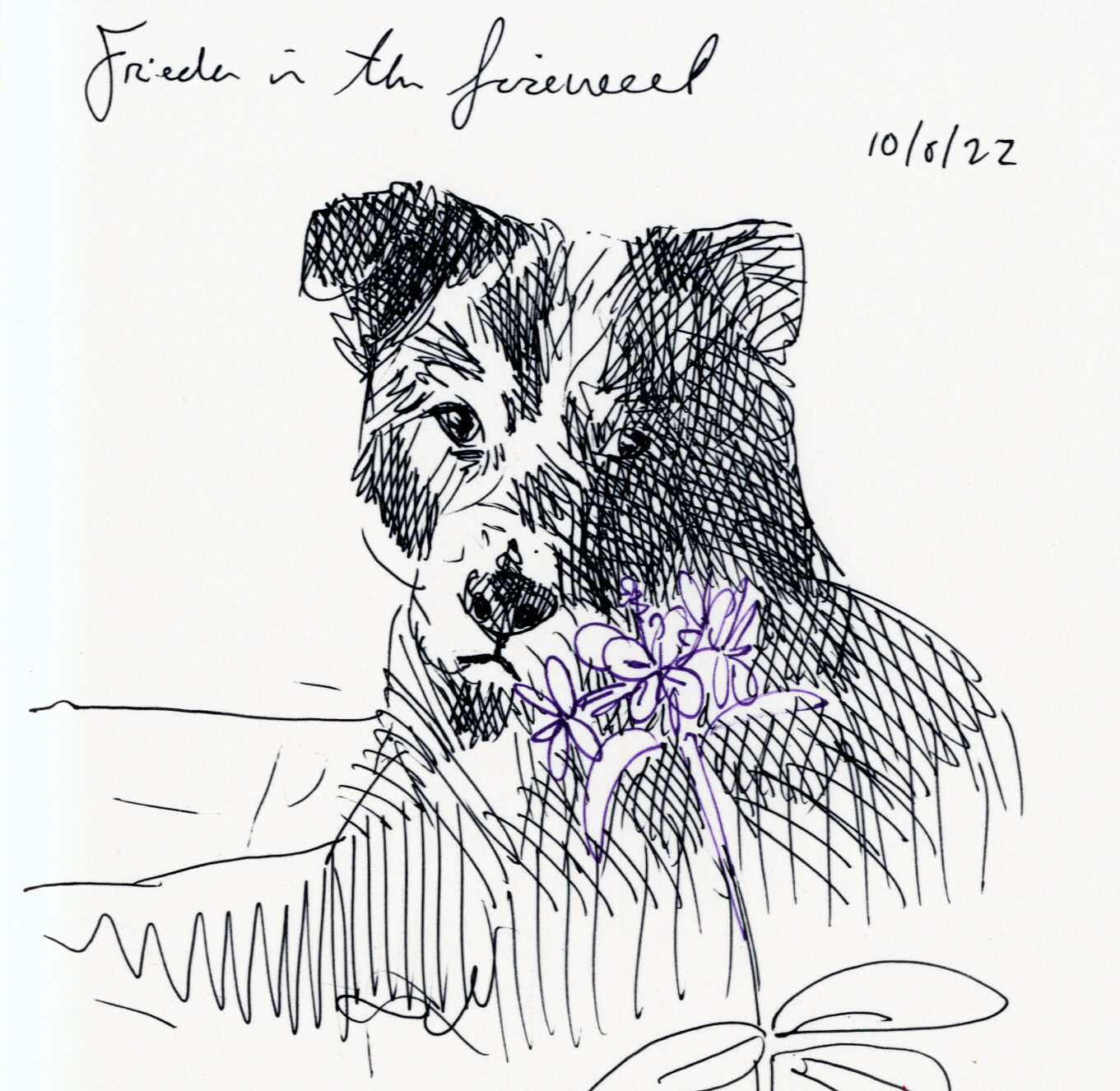
In memoriam of the author’s beloved dog, Frieda, March 2011–August 4 2026.
2026, August 4 – Day 0
I am standing under some trees in the breezeway between the front and back yards of my veterinarian’s office, facing forward toward the road and the traffic, and I do not look back.
I know what I will see if I look back: a dead dog lying on a blue towel on the moist green grass beside a picnic table. I have already seen her, already felt her side, quiet and still. I know that she is dead. I kissed her head and told her I loved her, that I forgave her (the wrecked curtains, the interrupted nights, the pee-stained sofa), and asked her to forgive me (unnecessary with a dog, but still meaningful).
I understand now why you should not look back on your way out of the underworld. If I look back all I will see is a dead dog. But if I look forward as I walk away the memories of who that dog was will be the stronger as they follow me, undimmed and unobscured by our final moments, into the living future.
2018, November – Frieda’s Flight
I was in Seattle, at a convention trying to make some money, when my petsitter called me in a panic. She had opened her door, and Frieda had burst out of the house before she could be leashed, dashed across the yard, busted through the gate and vanished into the night.
I stood behind my Artist Alley table, phone to my ear, hearing myself say “Put me on speaker and let me try to call her,” even as I felt my stomach shrivel up into a wrinkly little lump of stress.
Frieda was a 35-pound black mutt with a combination of terrier smarts and sighthound speed that, combined with her distrust of strangers and extreme attachment to myself made finding dog-sitters remarkably difficult. My roommate had agreed to watch my pets over the weekend, but had gotten a mutual friend to watch the dog for the one night she was going to be out of the house. Said friend had taken Frieda to her house for the night, on the theory that it would be better for Frieda to have someone with her overnight. A sound plan, and one I had agreed with. However the friend’s place was in the opposite quadrant of Bend, Oregon, from my house. Across a river, a freeway, a busy stroad, and a set of train tracks. And it was November, with a predicted low of 21° F.
We were both highly motivated to get Frieda back to my friend’s place before she tried to find her way home through the dark and car-filled night.
My friend at the con, Kiki, swooped in to cover my table with the practiced ease of a fellow artist who has also had pet emergencies while vending at a convention, and I went out into the hallway and hollered “FRIEEEEEEEEE-DAAA!” into my phone.
No luck.
Petsitter put it out on Facebook, and the last I heard that night was that Frieda had been seen crossing the freeway—using the Wilson Overpass.
I told my petsitter to go to my house, turn off the heat, shut the (indoor only) cats into the bedroom and open the patio doors and all the gates, so that if Frieda did somehow manage to cross from SE to NW Bend overnight she could at least go in and find shelter.
Kiki wrapped up the night for me, and it was decided (largely by Kiki since I wasn’t thinking very well) that I should get some sleep and, if Frieda was not accounted for by morning, make the seven-hour drive then.
I do not know how I managed it, but I did sleep that night. Partly from pure exhaustion and partly from denial that this would be the end of Frieda. She was a fae creature, and while rationally I knew she was a mere mortal mutt as susceptible to car-strikes as anything, in desperate times we reach for desperate beliefs, and I told myself that it was most likely that she would be in her own back yard—if not in her own house—when petsitter went to check the next morning. She had, after all, gone on walkabouts before.
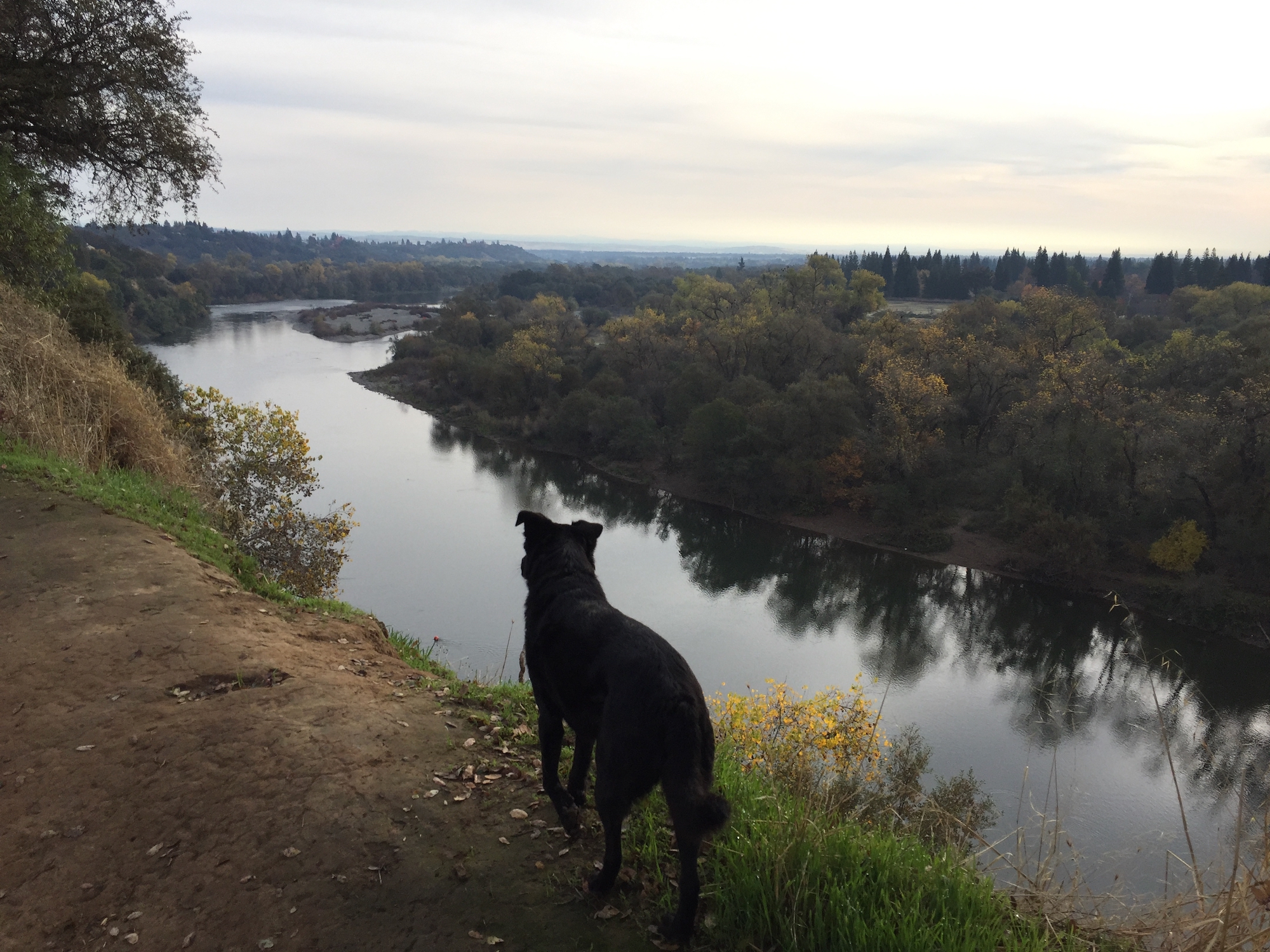
2026, August 5 – Day 1
I’m writing this the day after, sitting at my dining room table with Theory sprawled over my arms. If she is missing Frieda she’s only taking it out on me by being extra in-my-face and cuddly—though her baseline is so high it’s hard to tell.
I, on the other hand, am still a mess. Some of it I’m very conscious of—the puffy eyelids from so much crying and the kick-in-the-chest feeling every time I look over at Frieda’s bed and she is not there. Other things creep up on me.
I find myself looking out the kitchen window even though there’s nothing out there, because Frieda is not in the house so my subroutines assume she must be outside and it’s been long enough she must be waiting to be let in. Oof. Sitting at the table I keep glancing over to the living room to check on her. And she is not there. Oof.
Earlier, out running errands, I began to feel anxious of what I would find when I got home—was Frieda OK? Did she wet her crate?
Of course she didn’t. Oof.
I find myself stopping in odd places, reaching for a can of dog food she will not eat, pulling out pill pockets we don’t need anymore.
I am built of habits, and Frieda instilled herself in them as much as the necessities of my own life.
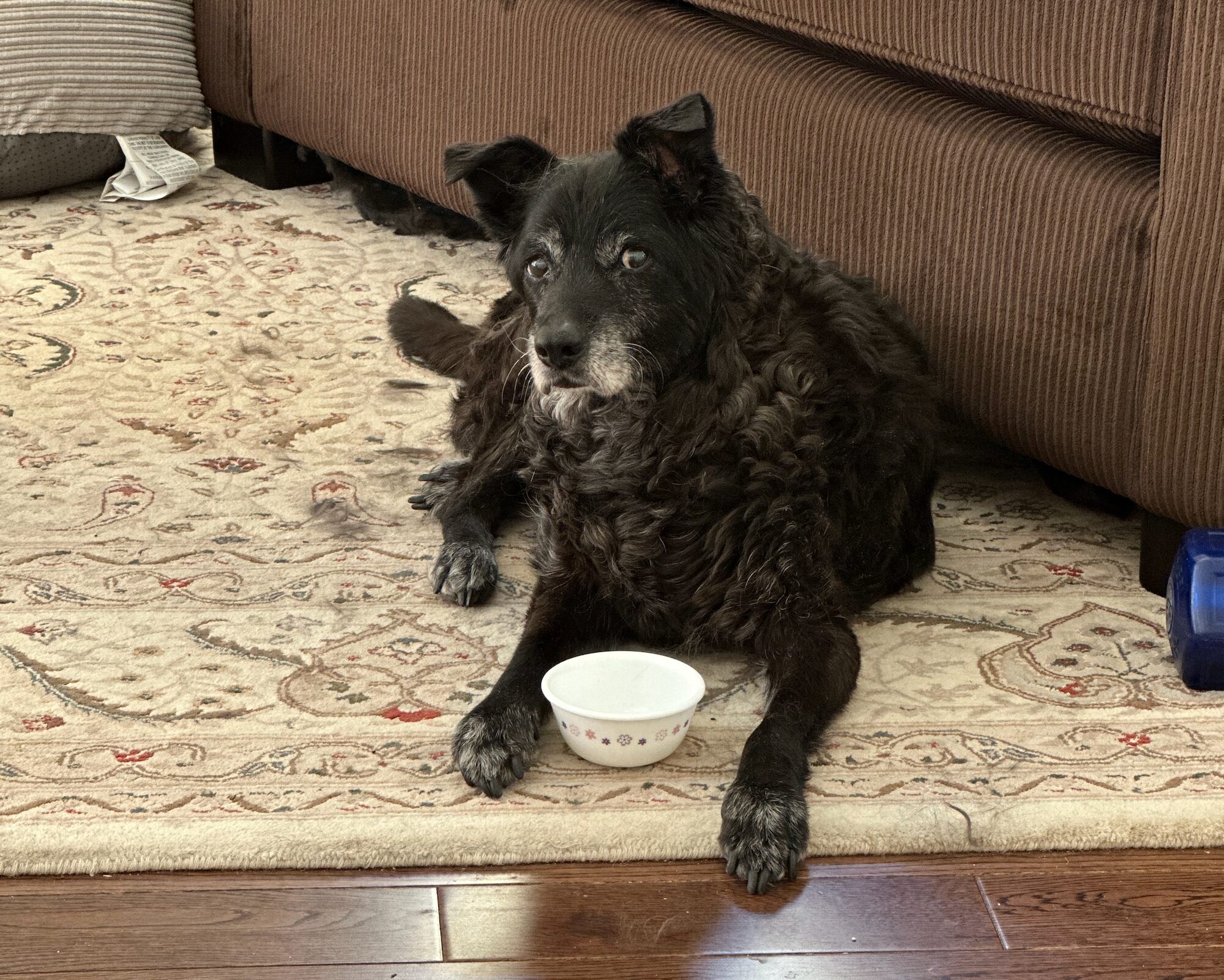
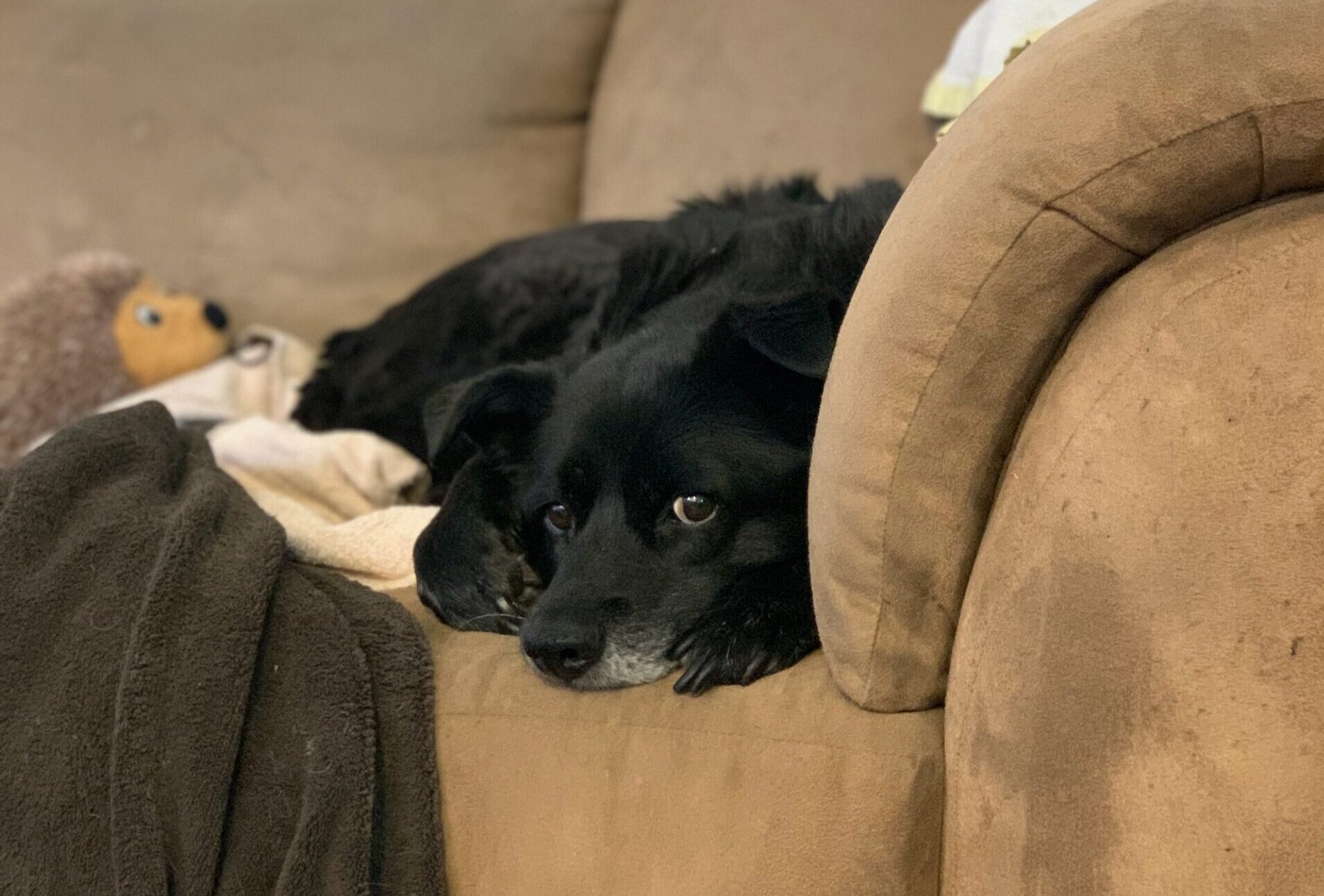
I look over at the carpet where she spent much of her last days and she is not there. But I can still see her. An old black dog, almost entirely white on the chin, her back bent and her skinny legs flopped out at odd angles, defiantly happy as she rolls around on the carpet, nuzzling at it before going to den in her dog bed. Or click-click-click-clackiting across the hardwood to get a drink of water. She developed Cushing’s disease in her last years which made her drink a lot. I will have to build new habits to keep the water bowl clean and full without her draining it daily.
Frieda was my rock, my anchor for fifteen years. Sometimes that rock was like a pebble in my shoe, and sometimes that anchor weighed me down when I would have rather drifted free, but she was an unwavering emotional support and was the black hole around which my galaxy rotated. I miss her. I will miss her. Always.
And I tell myself again and again, it will not always hurt so much.
December, circa 2012 – The Walkabout
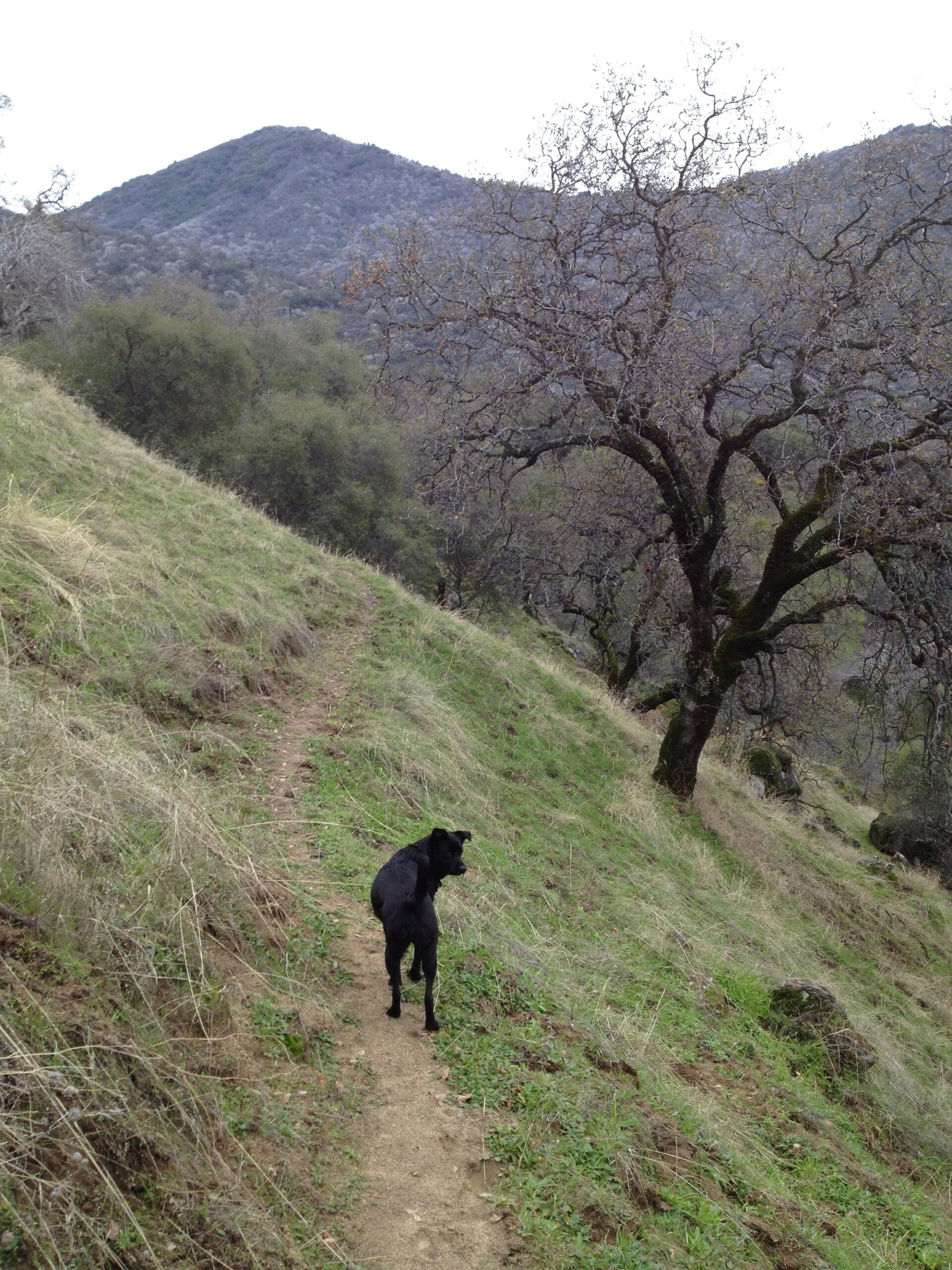
I think it was 2012. Might have been 2013. Frieda and I were both grown ups, but very, very young grown ups. One of my great ambitions at having a dog of my own was that I could train her to have decent recall and so go on hikes with her off leash and not worry about her running off and vanishing. Frieda made this all the more desirable since she was inoffensively friendly to every other dog she met and so averse to other humans I didn’t have to worry about her getting into altercations with either. But one winter day I learned that, no matter how good her recall was in our back yard, it was another matter entirely when we were three miles out from the trailhead on hundreds of acres of BLM ranch land.
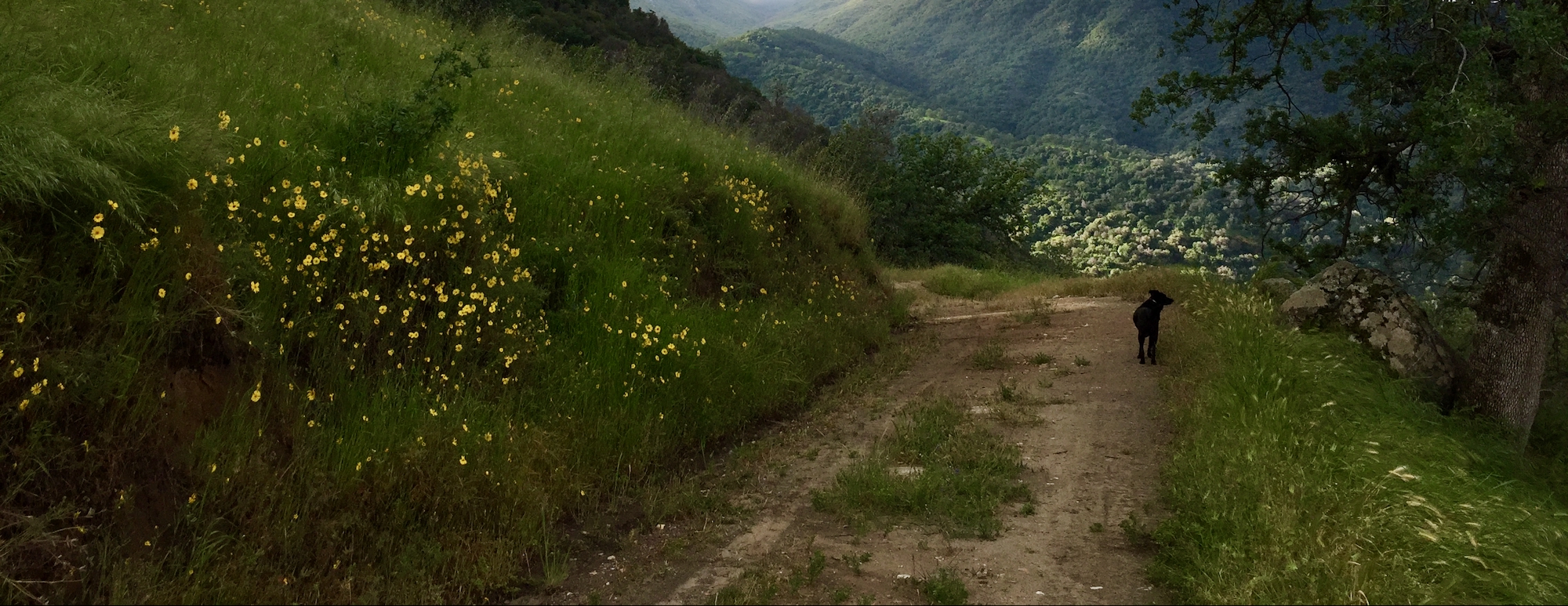
Specifically we were on a bit of doubletrack in the Case Mountain Recreation Area traversing the Cinnamon Creek valley toward a pair of waterfalls when Frieda saw something in the bushes and took off like a black streak up a near-vertical cliff and disappeared into said bushes.
I called her back. I waited. Nothing.
I whistled. Yelled. Shouted. Started walking along the trail as I called, with the idea that she would notice that I was moving on and, not wanting to be left behind, would leave whatever snatched her attention and follow me.
Nope.
I walked back. Shouted some more. Desperate, I followed in her track up the gully, bushwhacking through live oak and doing my best to avoid the poison oak, until I reached the ridge of the hill where another trail ran down to join the one that we were on. Then I worried what if she had gone in a circle? I started walking down the ridge trail until I had retraced my own steps to the point of our separation.
No dog.
What if she had gone on ahead?
I resumed the hike, calling intermittently, getting hoarser and hoarser, until I reached the waterfall. I told myself I would cross under it and hike up out of its ravine, and if I still hadn’t found her I would assume she’d lost track of me and gone back to the car. The light was fading anyway, and I’d need to get back, too.
She wasn’t waiting for me on the other side of the waterfall.
Crestfallen I turned around and began the long walk home.
Just after I re-crossed the creek under the waterfall, who should come running up the trail, tail high and tags flapping gaily under her chin, ears perked and eyes bright, but my very own Frieda, none the worse for her adventure and quite relieved to have found me at last.
I still have no idea where she went or what she did. My brother suggested that, since I was calling her so frequently, she’d simply been running around and comfortably tracking me by my calls. And he is probably right. She was probably not off in Faerie visiting her fey family. Probably.
But she was always a special soul, as her finder called her, and I wouldn’t have put a sojourn to Neverland past her.
2018, November – Homeward Hound
Seattle. Frieda went missing in the night. The next morning I got up and began packing. Sometime after I’d showered but before I’d had breakfast I got a text from my petsitter: “Frieda made it home! She’s in your yard and the gates are closed. Good girl Frieda.”
I don’t remember exactly what happened next. I laughed. I cried. I hugged Kiki. I went out for breakfast with another artist and ate some extremely extravagant donuts. I got upgraded from the artist alley to the dealer’s room at the convention, and went to work with renewed gusto.
Some years later (I don’t exactly remember when) I went hiking with Frieda out of Rimrock Trailhead, out the west side of town. Dubbed “Good Dog” because of all the dogs there, I’d let Frieda off leash but we’d gotten separated by a group of hikers. I could see her running back and forth, apparently searching for me. I called her, but there must have been an echo that bounced the sound around because she started running back toward the parking lot. I followed and was just in time to see her see that I was not waiting at the car, give a sort of doggy shrug, turn, and begin running down the Haul Trail back to town (and our house).
I yelled as loud as I could and waved, and luckily this got through to her and she recognized me, came tearing back down the trail, and we got to go for our planned hike.
And I knew I had been right to believe in her wayfinding abilities. But I took care that she would never have to use them ever again.
2026, August 6 – Day 2
Two days later. I am sitting at my kitchen counter with Theory in my arms. I have cooked corn on the cob and she knows it. She is just waiting for me to unwrap it so she can steal some. I cannot let her have it, because it makes her vomit. Oh well.
Every time the house settles and there is a sound, I worry it is Frieda in trouble. But it is not. Frieda cannot get into trouble any more.
It is a relief that hurts.
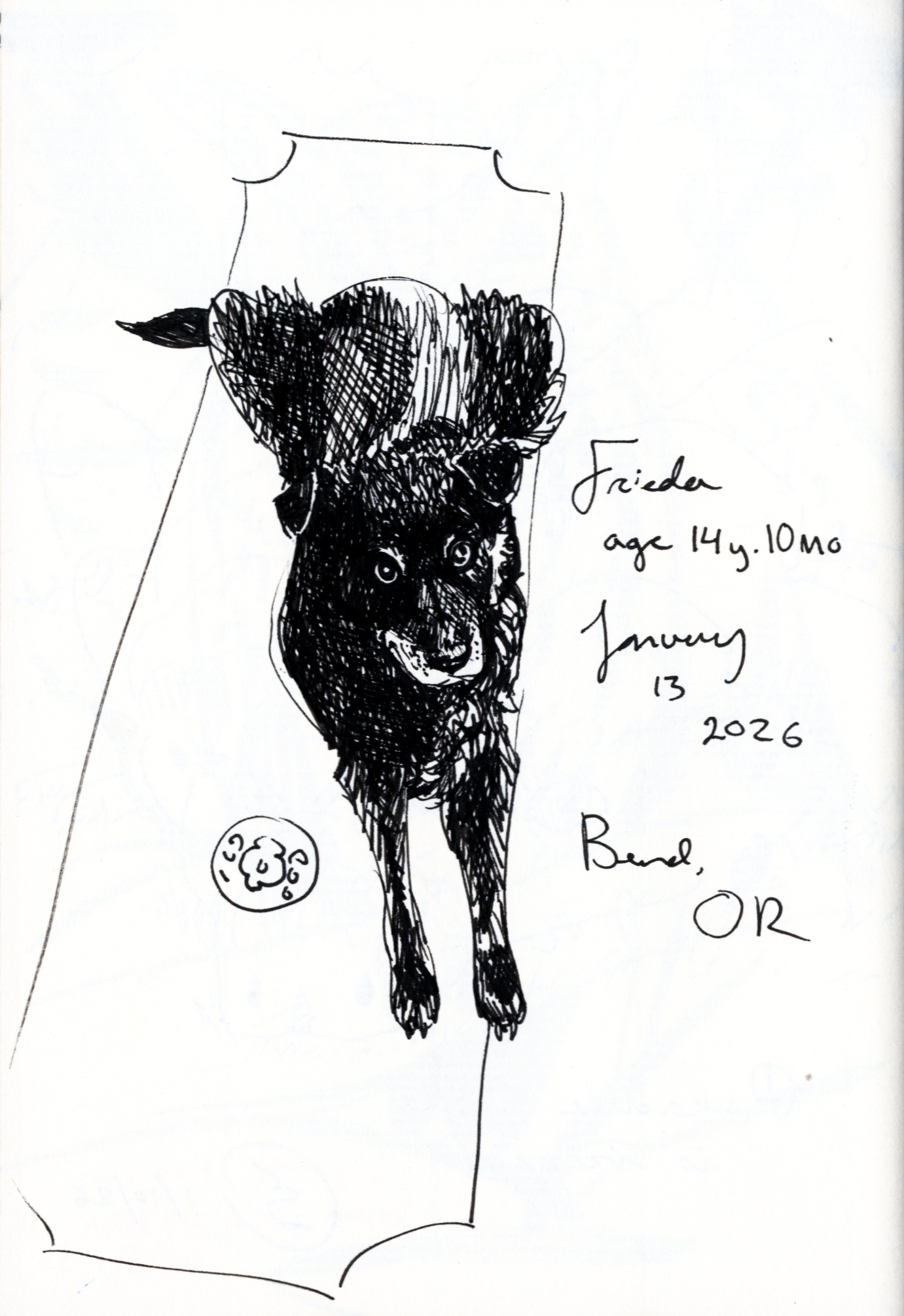
2020, October – Grocery Runs
With the pandemic came change in so many of our habits, but the one relevant to this story is that I went from doing weekly to bi-weekly to monthly grocery runs. Literally, I’d hook up the cart to my bike and ride the quarter mile from my house to Newport Avenue Market with Frieda running at my side—a safe distance from the bike.
Frieda had some of the worst separation anxiety I’d every encountered in a pet before. I wasn’t just her human, I was her assurance that she would be all right. When I wasn’t around she was liable to do extreme things such as destroy blinds, and when I left the house it was to the sound of her crying. So I took her with me whenever I could, including to the grocery store.
She loved it. She did not love the bike, but she loved getting to go out with me and run run run, down the alley, across 14th Street (the cars all stopped and waved us across when they saw the dog, such is the privilege of living in Bend) down the alley behind the Deschutes Children’s Foundation campus, then north on 13th to Milwaukee and diagonally across 12th to Newport’s western entrance, where there were a couple dog-friendly trees where Frieda suffered to wait out my trip inside, safely tethered and with the assurance that I would be back. It made the shopping go faster because I was always a little anxious about what I would find on my return. But every time I came out she was lying at attention, Dorito-ears perked, expectantly awaiting me. It was one of the few places she felt comfortable being left unattended. The other was outside Cuppa Yo Headquarters a few blocks to the east, which was a regular destination for both of us from the week we moved to Bend.
2016, September – Hey Let’s Go (Get Froyo!)
In 2016 everything changed, and I’m not even talking about that terrible election.
We—myseIf, Frieda and Chaos and Aether—moved from my childhood home and the only one they’d ever known in California, hundreds of miles to Central Oregon. It was the first time I had a place of my own—and what a place! A house in River West, within walking distance of shops, vets, groceries, pharmacies, dentists, and crucially within biking distance of the mountain biking kingpin Phil’s Trailhead. After two decades of living a thirty minute drive from vets, dentists, doctors, and more, it was like heaven.
It was also incredibly stressful.
Despite growing into young adulthood under my parents’ roof, the specifics of the situation necessitated that I become not only self-sufficient, but able to support my family in the day-to-day drudgery of the household. I thought that living alone would be a relief—I would only have one person to feed and clean up after, after all! And in a sense that was so, but it came with a boatload of other responsibilities I’d never had to navigate before.
Changing address, changing voter registration, changing dentists, doctors, vets, not to mention insurance.
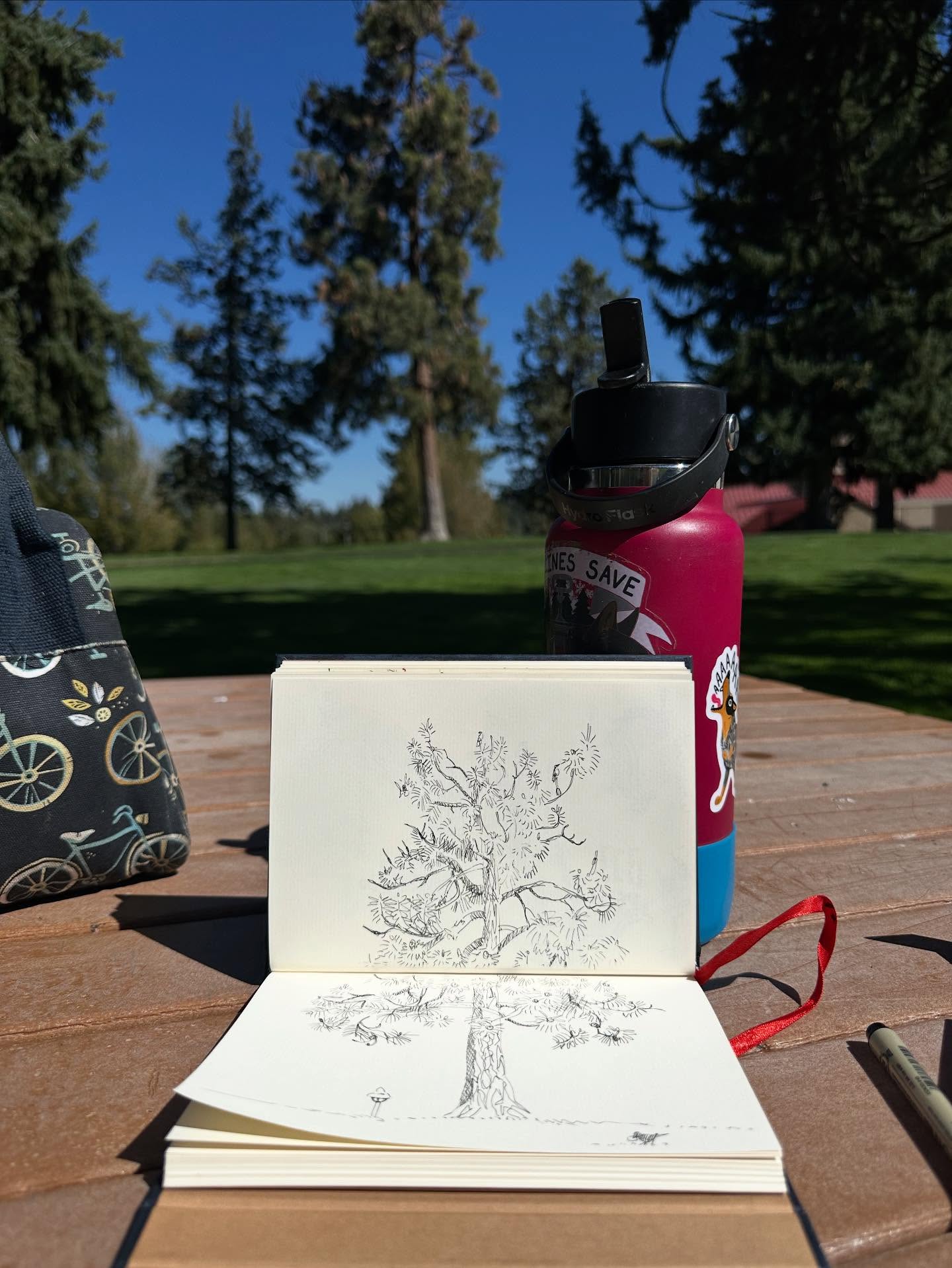
So while I was in many ways the happiest I had ever been, I was also the loneliest and the most frightened. At the end of my first solo week in Bend I took Frieda and walked down the half-mile or so to Cuppa Yo Headquarters, on the corner of Union and Newport Ave. Looking at all the interesting houses and trees on the way, feeling the chill air of a September evening, I sat outside on their convertible bench-tables and ate froyo and drew in my journal and watched Frieda watch the people going in and out of Spork next door and felt what I’d been telling myself all week. That things were going to be all right.
Thus began a tradition that would sustain me through the 2016 election, the COVID quarantine, the 2020 election, the death of two beloved cats and the highs and lows of 2024.
During the COVID shutdown I figured out that I could buy froyo at the flat (no toppings) rate, bring it home and enjoy it with my own toppings (popcorn is my favorite). With Bend’s see-sawing seasons, this meant the journey required different equipment depending on the time of year. On hot days I would need a cooler, sometimes with ice packs, to get it home unmelted. One winter it was so cold the soft-serve froyo had frozen hard by the time I got home. Frieda preferred the cold trips. Even when it was icy she had sure little feet with ice-pick like nails. But when it got really hot I’d have to carry her across the stretches of griddle-like asphalt.
I made up a song to sing as we walked, to the tune of “Hey let’s go!” from My Neighbor Totoro.
Hey let’s go
get froyo
My little doggie and me
Let’s go walking down the road
Ready set let’s get froyo.
The cars and trucks are far too loud
on 14th Street
But they won’t stop us from
getting to our cold sweet treat
Look at my cute doggo
Ready set let’s get froyo.
Down the hill, past Magnet School,
and all the VRBOs
Over the cracked brick walk
where some hyacinths will grow
Look at my cute doggo
Ready set let’s get froyo.
Hey let’s go! Hey let’s go!
My little doggie and me,
Let’s go walking down the road
Ready set let’s get froyo
Look at my cute doggo!
Let’s go get
Froyo!
Earlier this year it became clear that the mile round trip was too much for Frieda’s old body, so I got her a stroller. She wasn’t thrilled about it, but as it allowed her to continue to accompany me to froyo she still preferred it to sitting at home, and she certainly enjoyed having a little mobile bed to hang out on while I went inside to get our cold sweet treats.
The last time we went was Friday, July 24th. I remember she made it all the way to Cuppa Yo, but she was very wobbly and I put her in the stroller for the homeward journey.
Frieda is gone, but the stroller remains. Who knows, maybe one day Theory will be able to come with me. I’ll have to rewrite the lyrics then, but I’ll meet that challenge when I come to it.
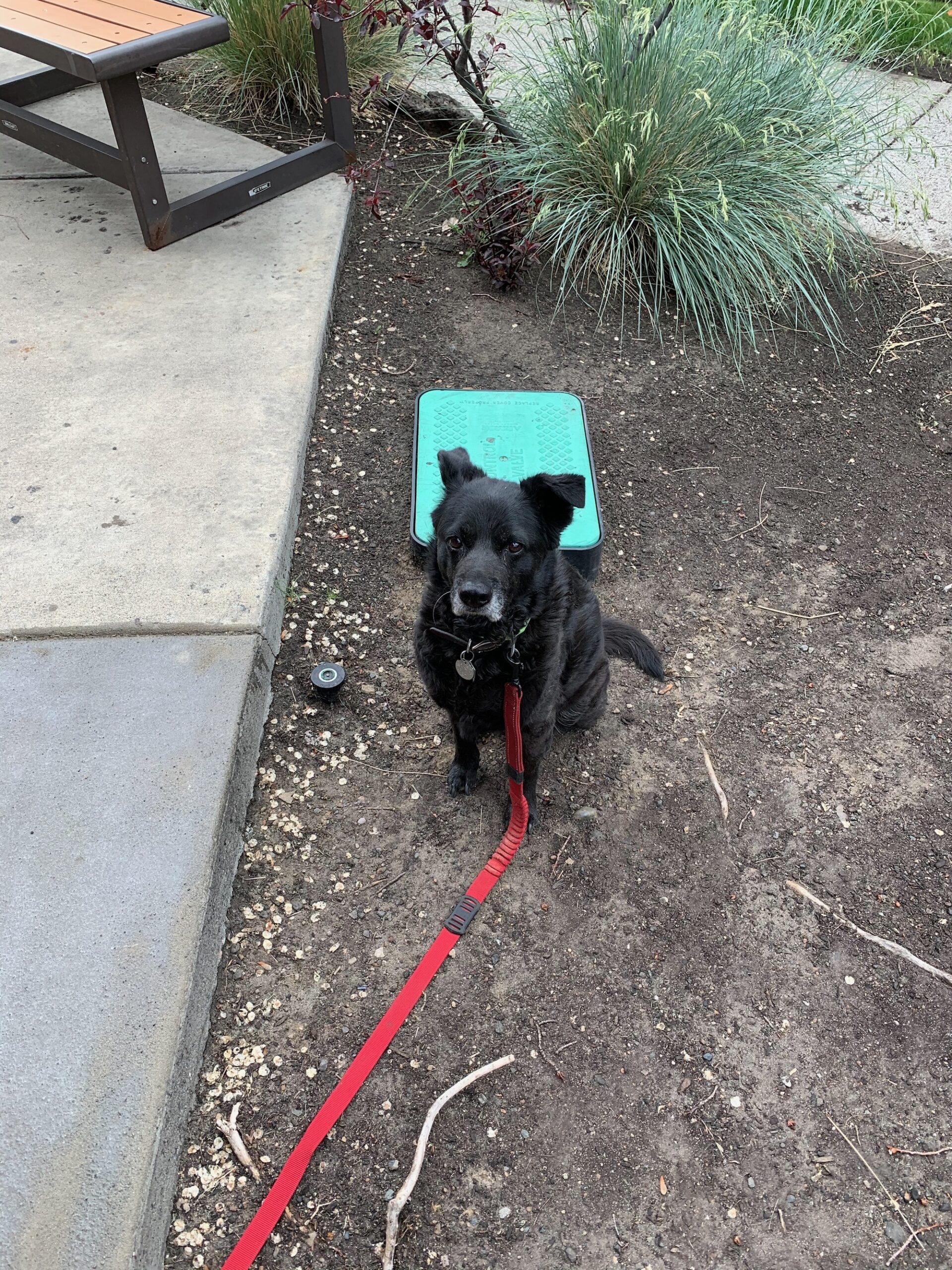
2026, August 12 – Day 8
I am writing on my sofa this morning for the first time and months, and for the first time ever, Frieda is not curled up somewhere nearby. It is the same sofa that I wrote most of Driving Arcana Wheel 4 on, first with her and Aether and Chaos, and then just with her and Aether, and then for a few sad months, just her, but then not long after I had her and Theory to help me write.
Now she is gone. The end of the sofa opposite me is empty, the spot on the carpet where she used to lie is unattended.
I am still looking for her in all the places she used to be. Last Sunday I found Theory waiting by the sliding back door. At first I thought she was just watching for birds or squirrels until I remembered that oftentimes Theory would announce that Frieda was ready to come back inside before Frieda herself did and she did so because she stood watch for her friend.
I wish I could explain to her what had happened. I wish I could reassure her that there will be more friends in the future. It will not always be just the two of us. But if I could tell her, I’d worry she’d be mad at me. She is that sort of cat.
On Monday I cleaned the house for the first time since Frieda died. I had to do a lot more cleaning than usual because ants had invaded over the week, and I found a trail leading to Frieda’s old crate—which had gotten plastered with remains of dried food in the last days. So I had to clean the crate one last time, but I left the bedding for later. Theory still sometimes goes in the crate, and I’d like to give her a way to be close to her old friend for as long as possible.
At the end of the day I bagged up all Frieda’s expired medications and pee-stained diapers and took them out to the bins. Some things I am not sad to let go of.
Yesterday was Tuesday, a week to the day since we said good-bye, and I brought her ashes home. Right now they are sitting on my island counter under the flowers my neighbor left me, in the default wooden box with forget-me-nots carved on it. Eventually I will make her a proper shrine, and probably get a special urn if I don’t make one myself, but this will do for now.
Theory has come to lie in my arms while I write.
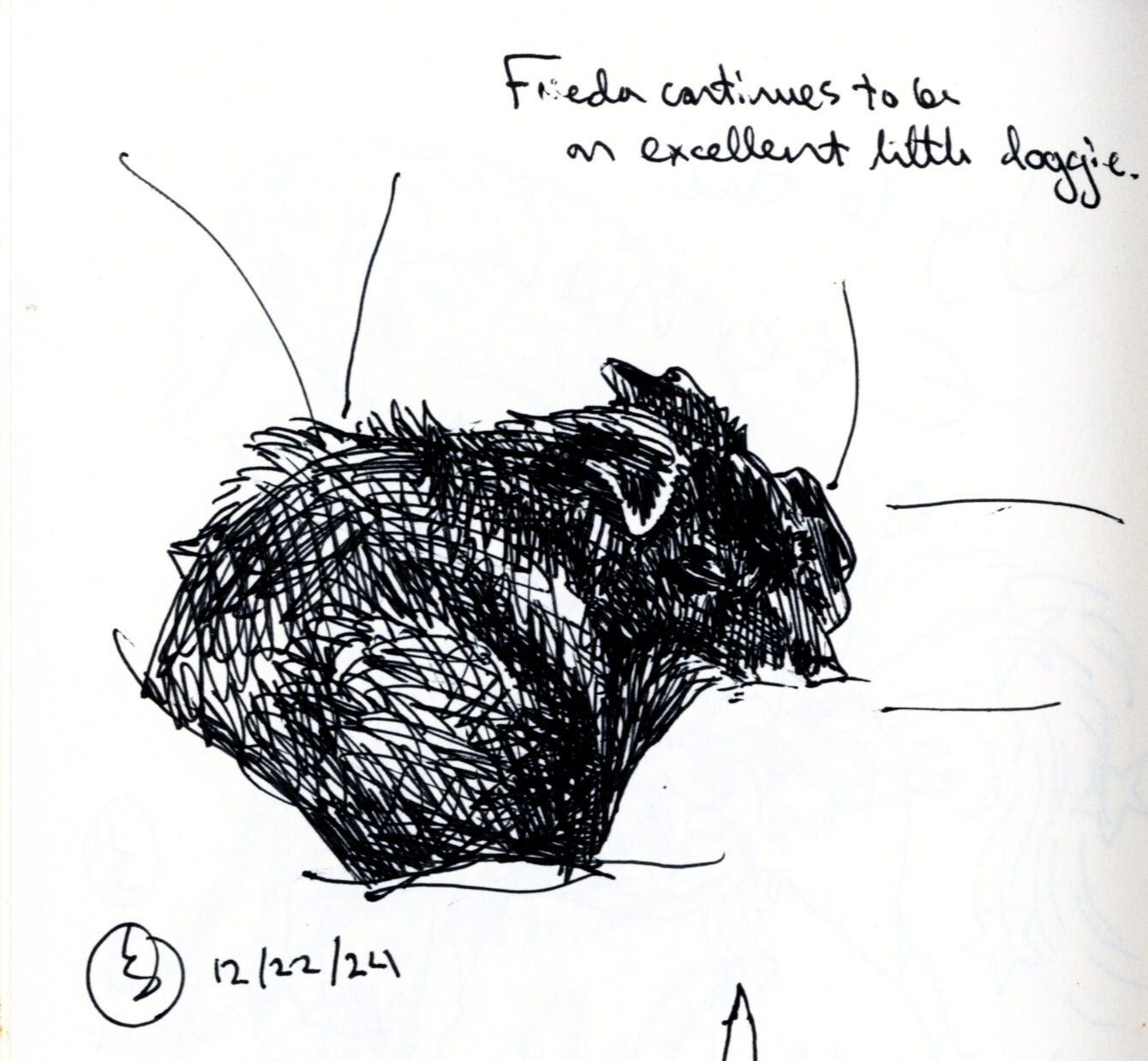
2016, December 8 – Scout
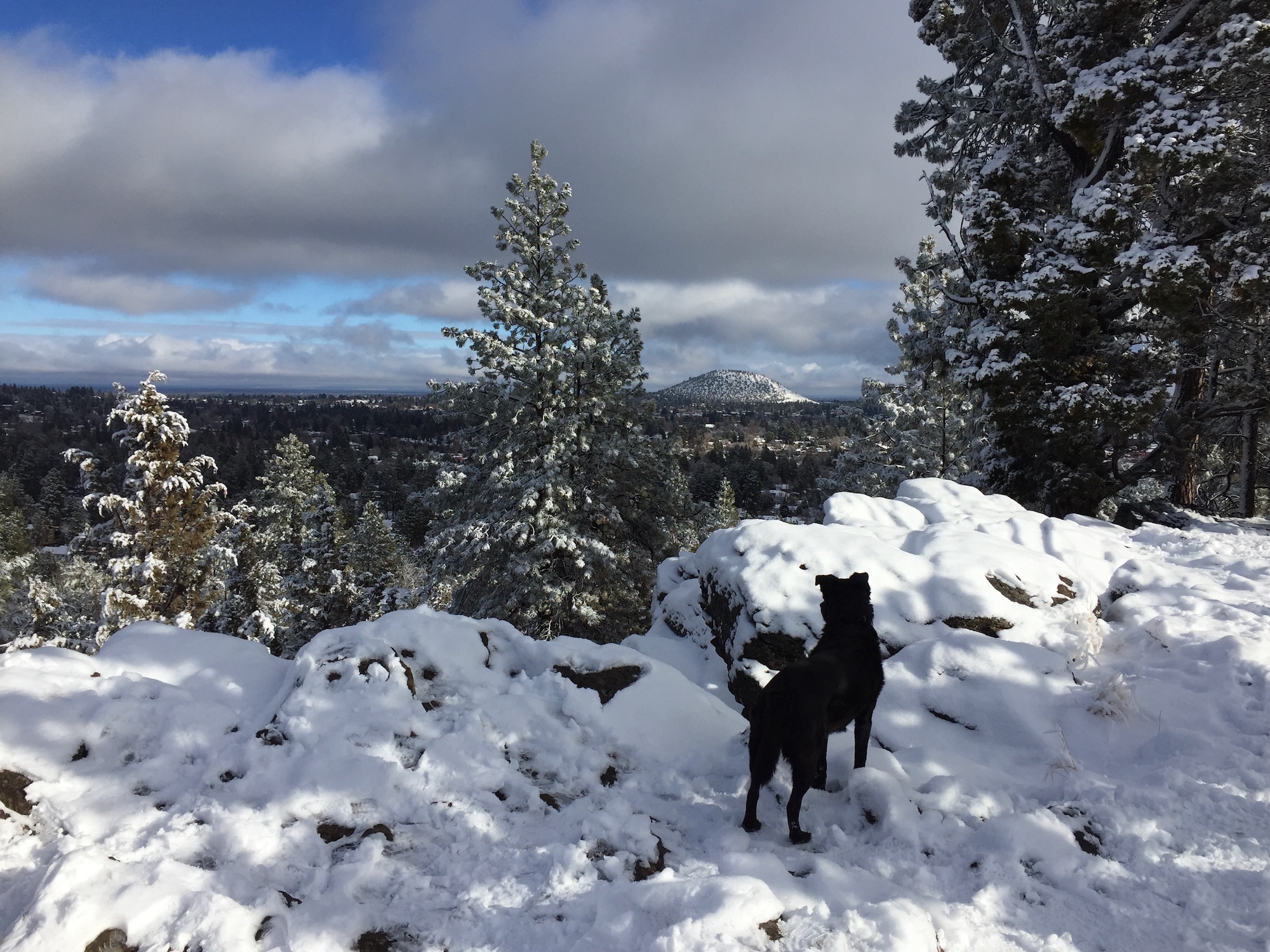
I thought I knew I didn’t know what I was getting into with Bend winters. I knew, for example, that growing up in California meant that snow was something you visited—or that visited you—for a few hours or maybe a day. Having visited snow I knew about chains for my car tires and a shovel for my walk and traction devices for my shoes.
I also knew I didn’t know what it was like to live in and around and with snow for weeks—months—on end. So I listened to what my new neighbors told me about the coming winter: I bought a snow shovel, yaktrax, and chains. I got two puff jackets off a friend who was moving. I put styrofoam blockers in the vents below my house and hired a landscaper to winterize my irrigation. But my neighbors told me that, while snow came for extended visits to Bend, it usually didn’t last very long.
I later learned that all these neighbors were basing their assessments on recent years, which had been affected by the overall warming/drying trend affecting western North America.
The winter of 2016-17 was a throwback—and perhaps the final furious frenzy—of traditional Central Oregon winters.
It started with a blizzard in early December which heaped mountains of snow on the town and flooded streets and alleys and parking lots. It drove me (literally) into Les Schwab to get the last set of studded snow tires that would fit my car, and then stalled me getting said car back into my garage since I had to hand shovel my alley first. The car battery nearly died. It was a whole thing.
The next morning I went out to finish shoveling the alley so I could get to 14th Street, which was by then nominally cleared by all the SUVs which had been bulldozing it.
City of Bend plows arterials first, leaving most of the city to its own devices to get to those arterials. Much of the city, I came to discover, either had SUVs, snowblowers, or skis. I had none of these so I began doggedly hand-shoveling out toward 14th Street from my driveway.
Thankfully I was not alone! After a little while a woman emerged from the house across the alley and joined forces with me. This was Martha, and we were Alley Allies from then on—helping shovel snow, keeping en eye on each others’ garages. Best of all, Martha had a little dog, Scout, who Frieda loved. They would see each other from streets away and begin tugging, and when they met it was a whirlwind of tails and noses and Territory Marking. Frieda was a gregarious dog to other dogs, but she especially liked Scout. He was—is—a very handsome chihuahua mix, and as such was small enough that his exuberant attention didn’t threaten Frieda like that of the shepherds and pitbulls did.
On our last trip to Cuppa Yo, even though Frieda’s eyes were almost entirely clouded by cataracts, she spotted Scout at the far end of the school playground as we passed, and perked up her head. But we had no time or energy to stop and say hi.
On our last day together I brought Frieda out into the alley and Martha brought Scout and the two got to greet each other and pee on the verge. Though she was tired and stiff, her tail went up and wagged one last time.
2017 – Hattie
Frieda was always a friend to other dogs. Even dogs that didn’t like other dogs liked Frieda, and some of this reflected on me. Many times when we were out on walks and she would greet another dog with a friendly wag and a polite ear and the human would say, “oh, my dog’s not friendly” and after a couple seconds the dogs were sniffing each others butts and sometimes asking me for pets as well.
This was a drastic change from my family’s old dog, Stella, who actively went out of her way to enrage other dogs and relished the fight. She was the dog equivalent of an Internet Troll. Stella had been dead for over a year by the time I brought Frieda home, but my mom would regularly wonder aloud whether, if they could have met, which dog would have “won.” Would Stella be able to antagonize Frieda? Or would Frieda be able to befriend Stella?
As Aslan once told Lucy, we can never know what would have happened.
What did happen, though, was that we met Hattie.
Hattie was an old, old cattle dog who would occasionally wander down our alley, growl at me if I was at work in the garage, then wander away again. We would also see her on our walks, except when I was with Frieda those growls would be followed by grudging butt-sniffs and copious wagging of Frieda’s tail. Hattie was never friendly, but she was polite and respectful of Frieda, and eventually Frieda convinced her to accept treats from me.
Finally one day we walked passed Hattie’s house and her human was about as well. As Hattie came growling out to greet us like a grumpy old grandmother I asked him—as one does when the relevant human is present—if I could give his dog a treat.
“Well, you could try, but be careful…” he began.
Before he’d gotten to the end of his sentence Frieda and Hattie had said their hellos and then both turned to me for their treats.
“Wow,” he finished. “That… never happens.”
“She makes me look good,” I explained, rubbing Frieda’s ear.
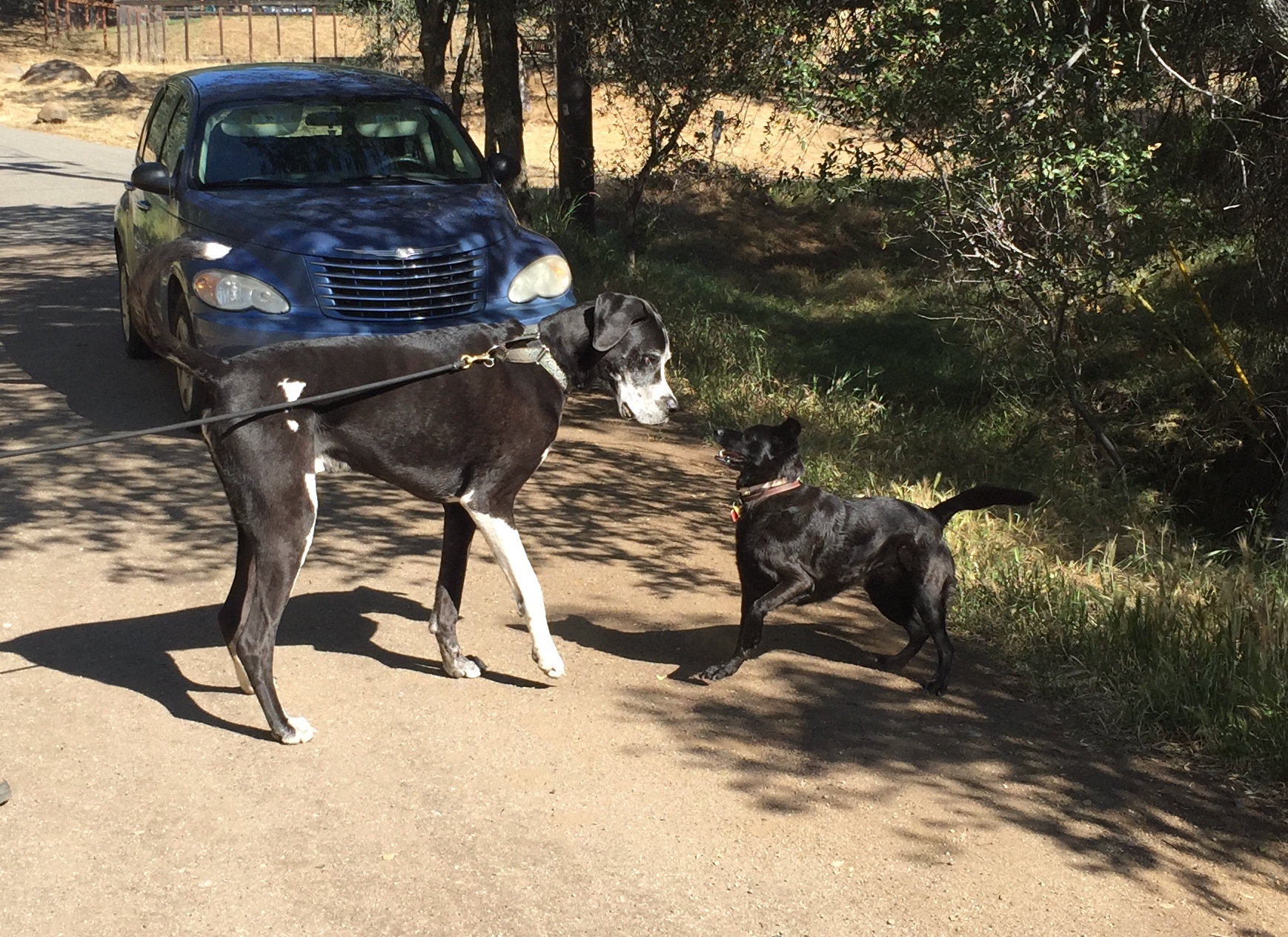
April 27 2015.
2026, August 14 – Day 10
I am home sick from work today. Yesterday I was congested and snotty, my muscles ached and it felt like my trachea was lined with sandpaper. I couldn’t tell whether it was a reaction to the smoke that’s been inundating Bend for the past three weeks, a summer cold, COVID, or just the culmination of a week without proper sleep, so I called out and went to Urgent Care. The doctor told me firmly that it wasn’t COVID (yay for rapid molecular tests) but that it could very well be a common cold or a reaction to the smoke or a combination of both. So this morning I am home and resting with the help of Claritin, Flonase, and Theory.
2021, September 10 – Friend of Cats
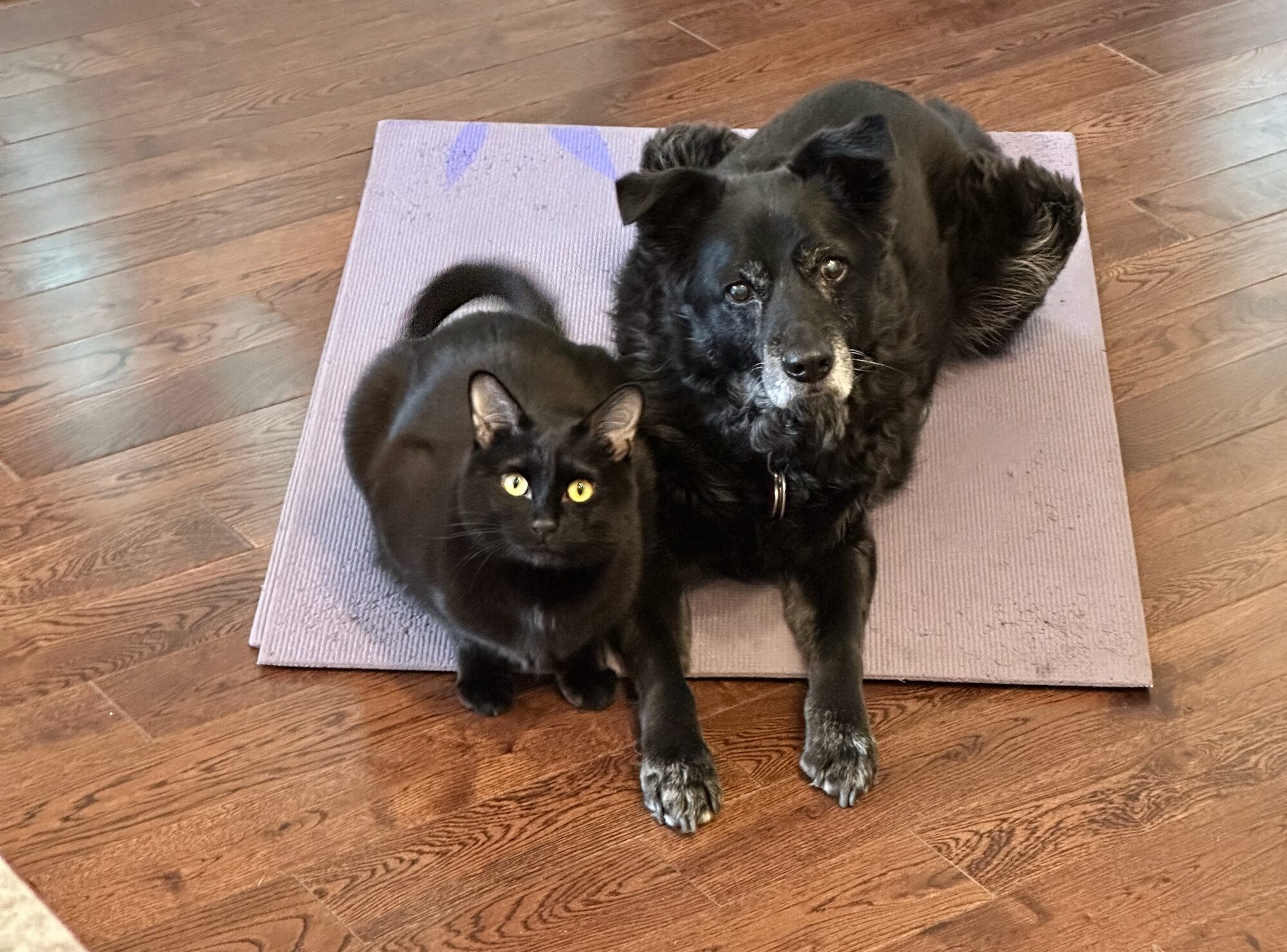
Ten years almost to the day since I first met Frieda we went together to our local shelter to meet our newest friend. For the last two months I had been cat-less for the first time in twenty years and it was time to remedy that. So we went to the shelter and adopted a little black kitten with huge yellow-green eyes and an even bigger voice.
I took it very cautiously introducing the two, even though Frieda had demonstrated over the course of her life nothing but affection for cats. I put Frieda’s crate in the room I had set aside for little Theory and then put Frieda in it, then sat down between kitten and crated dog and took turns giving each of them treats. Theory, far from being frightened of the big black beast in the crate, tried to play with her through the bars. And when I eventually opened the crate she took one sniff and then climbed bodily inside. The rest, as they say, was history.
I did not know about Single Kitten Syndrome at the time. That is the unfortunate result of an under-socialized kitten who has not been taught by another kitten or young cat how to play politely with other living things. Hence the advice to adopt kittens in pairs if you don’t already have a young and playful cat handy.
Frieda wasn’t young and she wasn’t a cat, but she was thirty times Theory’s size in the beginning and she modeled soft mouthes and gentle paws brilliantly. When your play partner’s foot is as big as your head you learn fast not to bite too hard. It was sometimes alarming to watch as Frieda played, open-mouthed, with the tiny kitten, but she had scrupulous care of her un-asked-for sibling and provided Theory with an impeccable warm and cuddly mountain to explore. And when we returned from extended trips it was Frieda she gravitated to first, following the dog around and grooming her, ignoring for the most part the human bringing in the baggage.
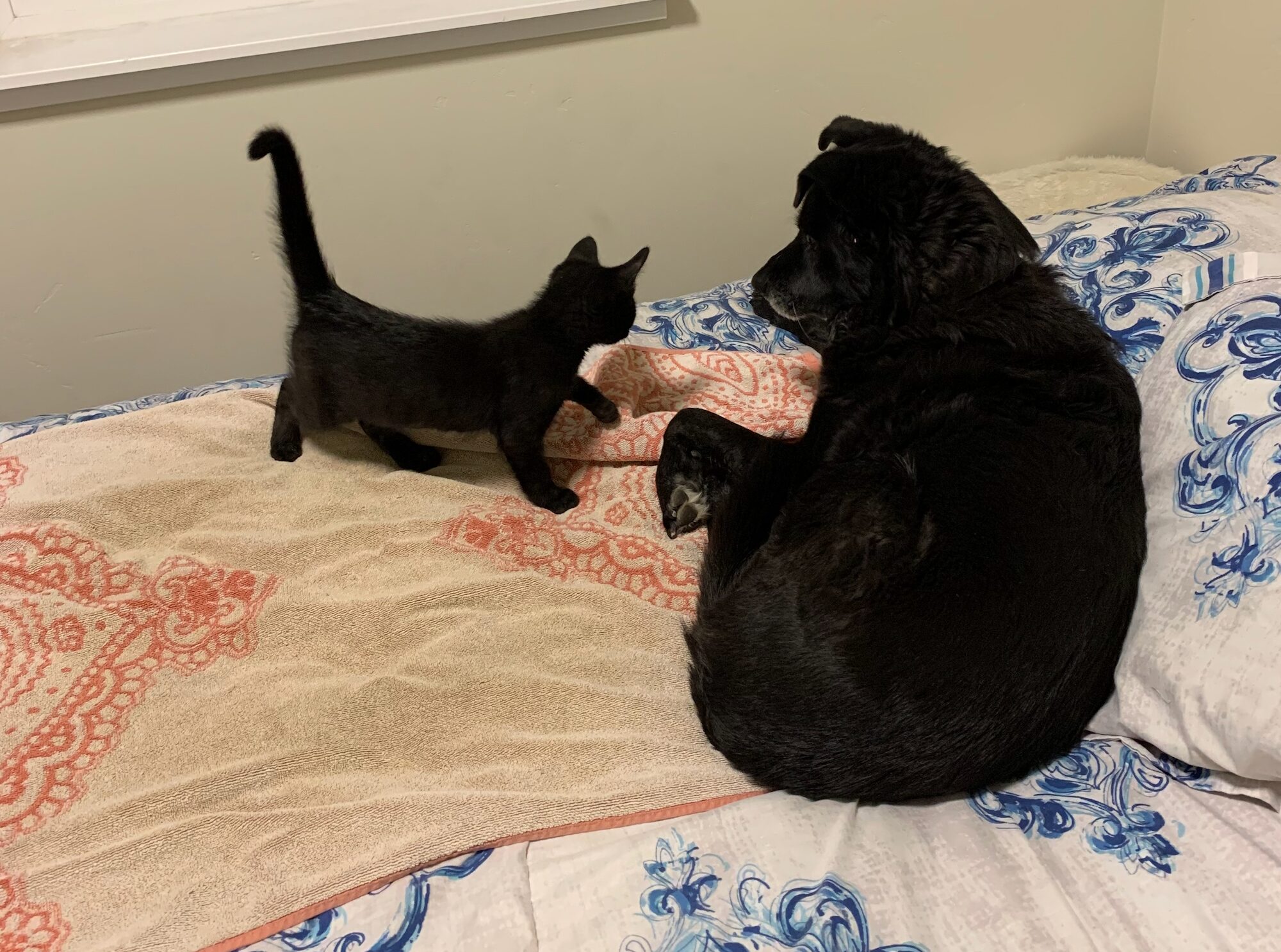
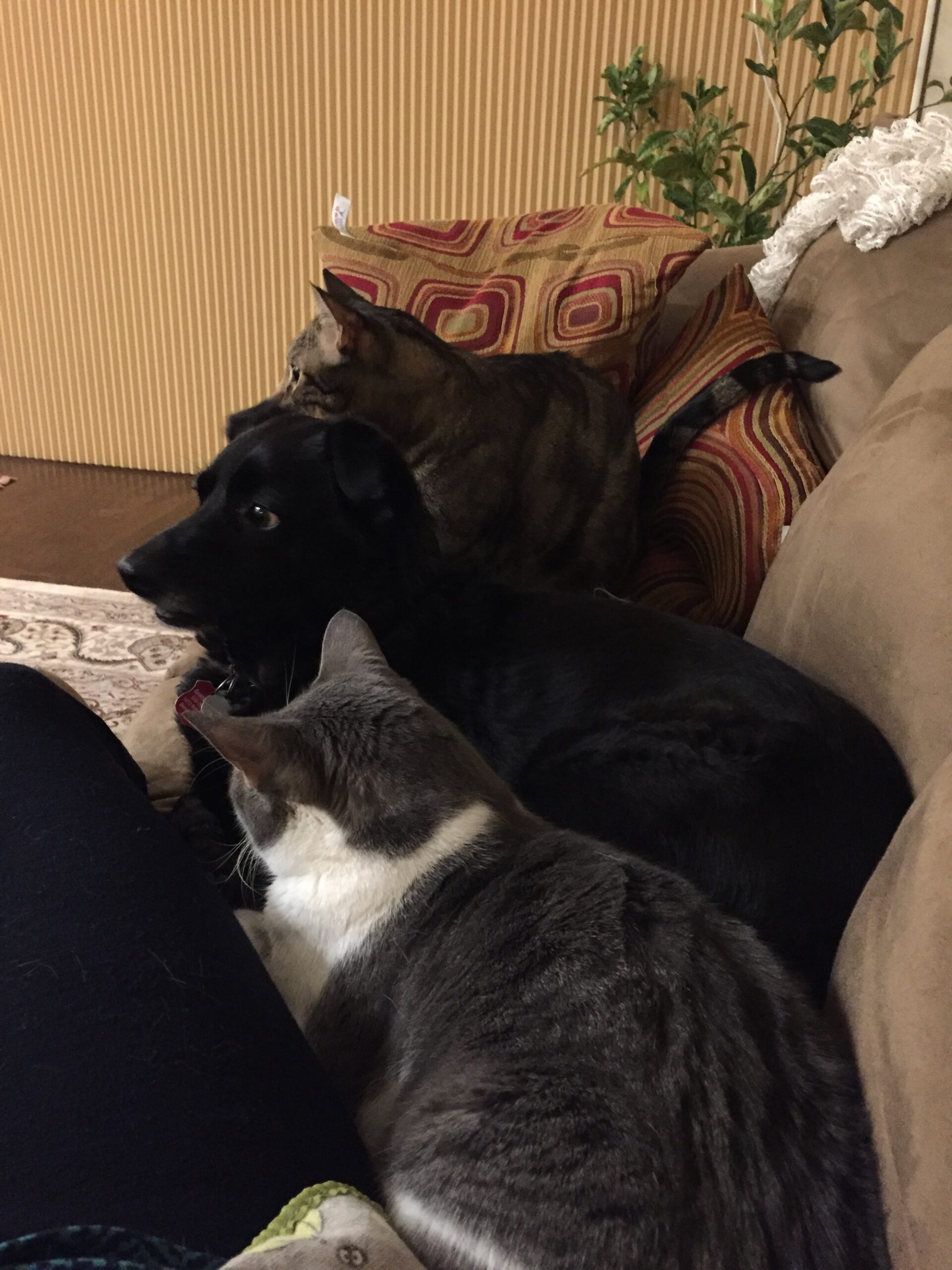
As much as Frieda was a bit of a mom to Theory, sometimes their roles were reversed. Theory looked out for Frieda when Frieda was outside, sometimes alerting me of the dog’s return before I ever heard a “woof” from beyond the door. And part of her evening routine was to groom Frieda’s face, which Frieda tolerated with characteristic nobility. She was used to receiving the affections of cats, having been raised herself by Theory’s predecessors: Aether, Chaos, and Scruffy—and to a certain extent my brother’s cats, Boss and Mook.
I always joked that Frieda was bilingual, fluent in both Dog and Cat, and that she was the most cat-like dog I’d ever met. To her I don’t think there was a distinction between cats and small dogs. They were different shapes and made different sounds, but they were both seen equally as Friend.
2015, August – Post Peak Pass
Anyone who saw Frieda in the last two years of her life might have been hard put to imagine that, as a young dog, she had the dexterity of a mountain goat and the jumping ability of a frog.
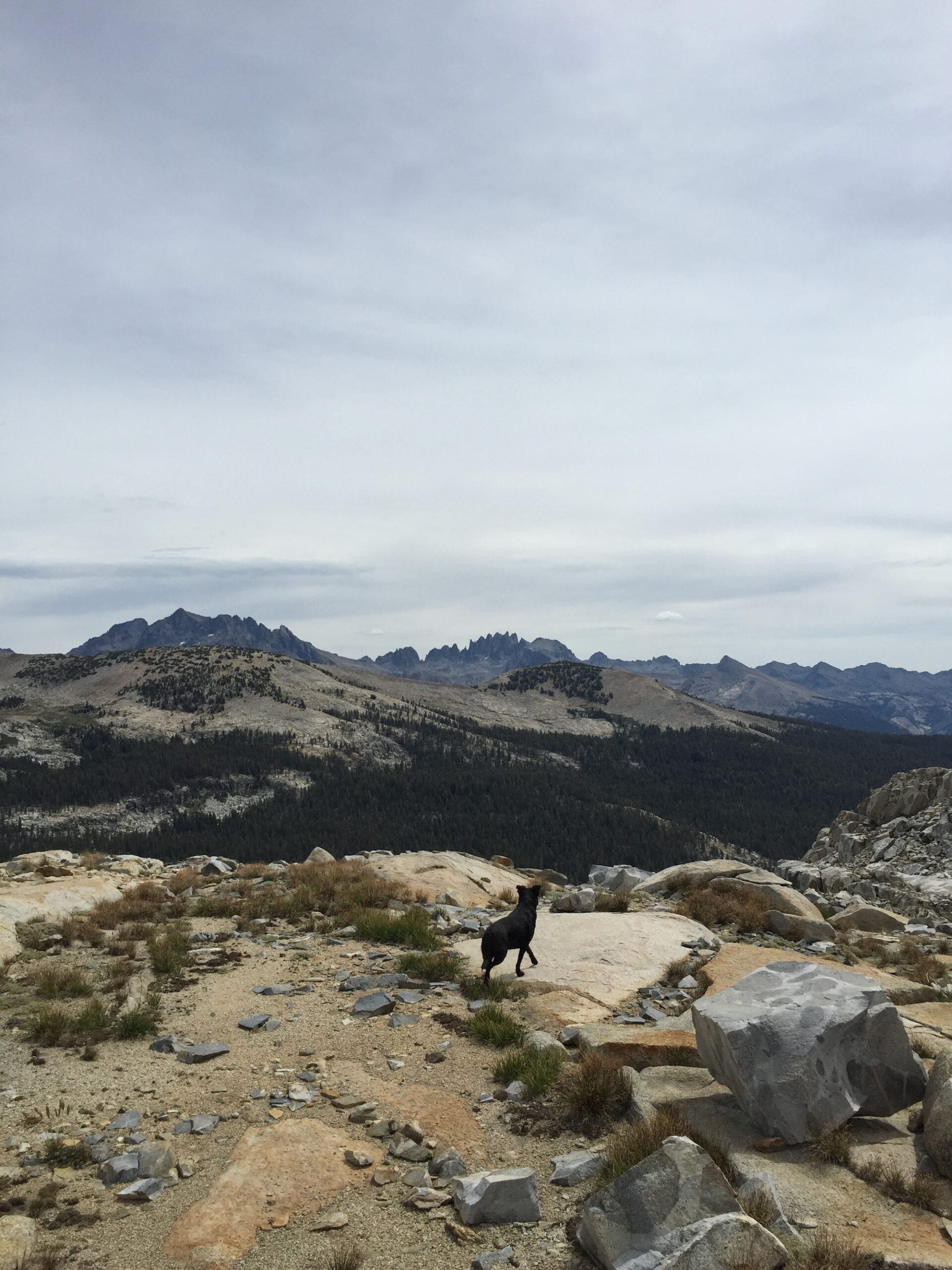
In an August only a little less smoky than the one I am writing this in now, Frieda and I accompanied our cousin, aunt and uncle on a backpacking trip through Sierra National Forest and John Muir Wilderness to Joe Crane Lake, where we camped for a couple nights and made day hikes up and around the beautiful rocky mountains. Because dogs were allowed not only did Frieda come, but so did Dante, aunt and uncle’s big shepherd mix, and Pancake, the cousin’s tiny yorkie mix. It was my first time camping with Frieda, and at night I slept with her on a leash at my side, fearful of losing the little black dog in the big dark night. Frieda loved it.
Frieda loved being essentially joined to me at the hip but also free to run around the endless forest and sniff everything. She loved climbing up boulders and surveying the way ahead, even when said boulders got higher and slipperier and the cliffs below steeper and deeper.
One of our day hikes took us up above the tree line to Post Peak Pass, where we could look over towards great Yosemite. I remember seeing nothing but waves and peaks of grayish brown stone, wind-polished and dry, and my uncle remarking that the place was beautiful but austere. Now whenever I hear that word I think of those high and distant mountains, and the remarkable rocks with their swirls of marble, granite and quartz.
You can look at Post Peak Pass on Apple Maps, and if you do you’ll see what appears to be a lot of gravel, with a pile of gravel to the south labeled Post Peak, 11,010 ft. What you don’t necessarily realize is that each piece of gravel is a slab of rock the size of a refrigerator. So even though it wasn’t exactly a feat of mountaineering to summit Post Peak, there was a decent amount of climbing involved.
Remarkably, Frieda made it—by leaps and bounds and a few scrambles—very nearly to the summit. Eventually my nerves couldn’t take it any more and I called it for us. We rested in the shade of a refrigerator-boulder while uncle and cousin went on, looking out over the sweeping basin of Joe Crane Lake and the distant greenish ridges below.
On the way down we looped around a ridge with a view of another lake, and Frieda at one point got rather further down the cliff than we expected. Rather than retracing her steps like a sensible being she leapt a ravine to rejoin us. Terrifying for me, since I would not have been able to go down and fetch her—the rocks were too slippery for me—but for Frieda I don’t know if she ever had a better day.
Once I spotted her, standing on a jut of granite looking out over Ward Lake and the descending ridges, a small black spot on that pale grayish landscape. It seemed in that moment she stood with two feet in the world of wild things that are not owned by humans, but by the land they stand upon.
I like to think, in her old age, when her joints had frozen and her eyes were veiled, when she dreamed so vividly that her paws trod the air and her tail thumped the carpet, that she was remembering that high and mighty place, and her time running through its stunningly beautiful austerity.
I like to think, now that she is gone, that is where her spirit has gone to.
2011, September – A Special Soul
The woman was sitting outside Anne Lang’s Emporium beside a rickety metal table—the kind made of woven strands of metal, so spilled crumbs and milkshake could fall through and get on your lap—and the dog lay beneath.
I went to them because of the dog. I didn’t think much of it in the moment. As I explained to the woman, my family—and by extension myself—had been dogless for well on a year and I was suffering from dog-deprivation.
“Can I pet your dog?” I asked.
“You can have her, if you want,” replied the woman. She was middle-aged, kindly, dark hair salted with gray. Probably not much older than I am now, but a lot more dignified.
“Ha ha,” I said, bending down to pet the smooth head and soft ears of the small, black dog. Though hardly more than a puppy she had a couple white hairs at the nape of her neck and big brown eyes that bulged out of her face, pushed by inner anxiety as she meekly accepted my affection. “How is she with cats?” I asked, still not entirely serious.
But a little serious.
We had four cats, all of whom had lived with our previous dogs, but I knew some dogs who were cat-eaters, and that was a non-starter for me.
“She loves cats,” said the woman.
It came out over the afternoon that the dog, named Frida after Frida Kahlo, had been picked up off the side of a highway by a livestock vet a few months ago. Her mother and all her littermates were dead. The woman was fostering her, but looking (clearly) for someone to provide a forever home.
Parental permission was required before I could bring a dog home. It was got. Less certain was the permission of the family cats. It was agreed that Frida should come to stay the night for a trial.
My dad knew the woman through some connection or another, so he brought Frida home a couple days later. Frida promptly hid under my desk, a miserable little ball of black with two bulging, frightened eyes. The only things she wasn’t scared of were the cats, who after the initial surprise quickly came over to introduce themselves. Frida’s response? To groom them.
That night I fed her dinner from my hand, then picked her up and carried her—contrary to what I’d told myself I would do with my next dog—over to my bed, where she spent the night curled up beside me.
From then on she was my dog, but more profoundly I was her human.
And so it went for fifteen years. “Frida” changed to “Frieda” because I got tired of people mispronouncing it (did Kahlo have this problem?) and she eventually accepted my brother as her secondary human, but little else changed. She was always shy of humans—especially men, excepting my brother—she always wanted to be friends with any dog or cat that crossed her path, and anchored my life through loss and upheaval, a relationship, a move, a new job, and a pandemic.
Thank goodness for art. Writing this has been a balm. And from the work of other artists, I know I am not alone.
Lines from stories that didn’t resonate with me before come echoing back to me now. I kept hearing Hans Zimmer’s Gladiator soundtrack in my head as I drove Frieda to her final appointment, and finally I realized it was because it went with Juba’s closing line.
“Now we are free. I will see you again, but not yet. Not yet.”
Now we are free. Frieda free of her arthritic joints and bloated gut and incontinent bladder and pockmarked liver and enraged pancreas and clouded eyes, and I am free from my anchor, free to lay down a burden I have carried for years and sail off to new places.
I remember the Calvin & Hobbes strip Bill Watterson made after his beloved cat died.
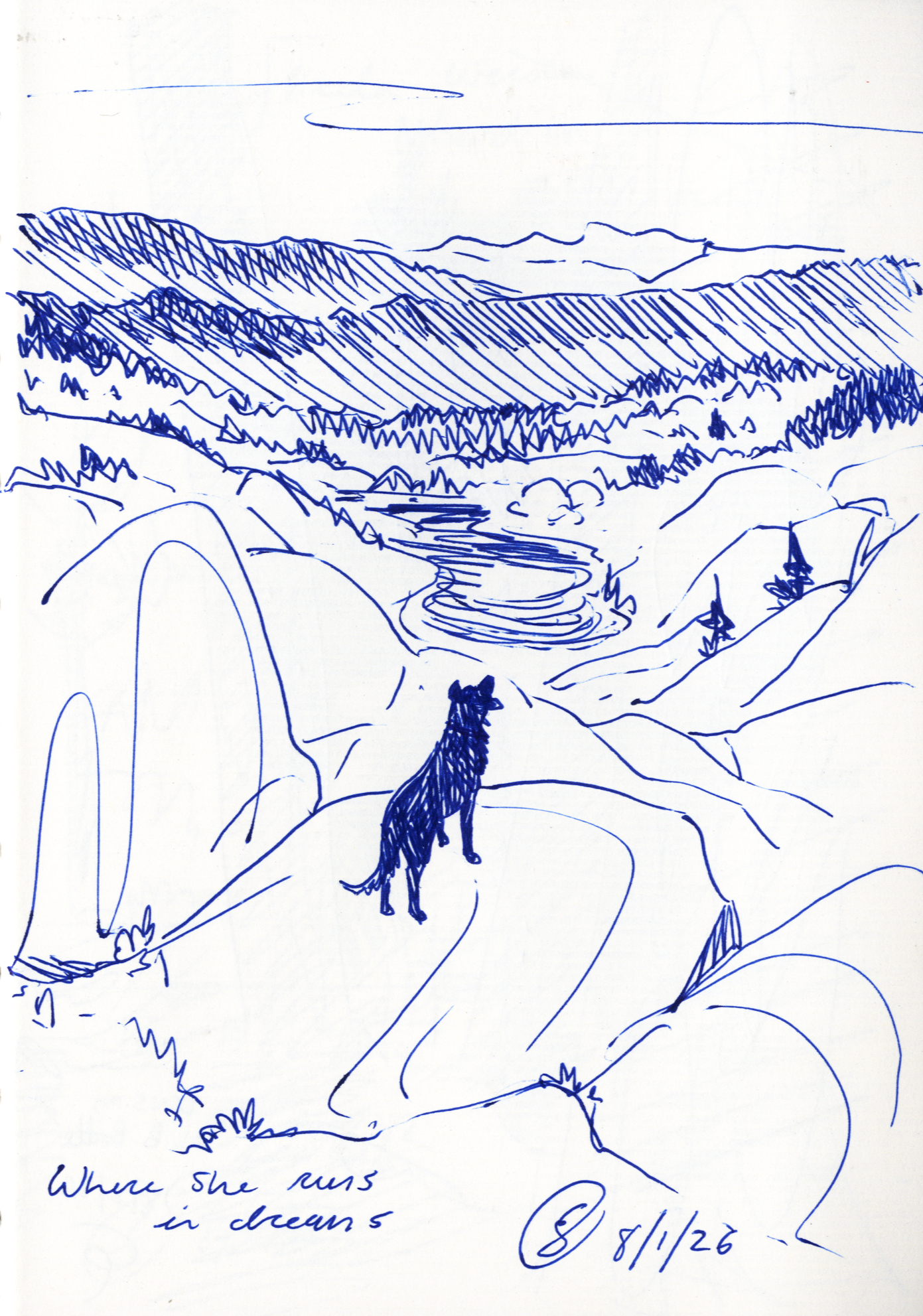
We can always be together in our dreams.
In her honor please refer to the Wilson Ave. Overpass in Bend, OR as Frieda’s Crossing. And, if you can, take your dog for a walk. You regret all the walks you don’t take.